Emergency Family Tents
Temporary household shelters with an outer cover, inner living area, groundsheet, ventilation, entrances and optional internal privacy partition.


Purpose-planned temporary shelters for government buyers, humanitarian organizations, NGOs, relief contractors and emergency-response programmes. Al Mumtaz Tents reviews the required specification, climate, quantity, testing, packing and delivery scope before manufacture.
Dubai is home to UNHCR’s largest global stockpile, located at Dubai Humanitarian—the organization formerly known as International Humanitarian City. This makes the UAE an important humanitarian logistics location for emergency stocks and international dispatch.
Source: UNHCR’s United Arab Emirates country page. Al Mumtaz Tents’ location in the UAE does not imply membership of Dubai Humanitarian, a supply agreement, tender preference or endorsement by UNHCR.
Refugee and emergency shelters are normally bulk-sale products, not routine commercial event rentals. The buyer distributes or prepositions the units, so repeatable production, compact packing, traceability, spare components and destination logistics are central to the offer.
Large agency purchases are awarded through formal procurement processes. A manufacturer may need supplier registration, financial and ethical documentation, a compliant technical offer, samples, accredited testing, factory inspection and ongoing quality control.
UNHCR published ITB 1865 for frame agreements covering Family Tent and Plastic Tarpaulin Eco-design. This illustrates why suppliers should monitor live procurement notices instead of relying on copied historical specifications.
View the archived UNGM procurement notice
This page is informational. It does not state that Al Mumtaz participated in or received an award under that tender.
The tent, site, drainage, WASH, access, fire separation and community facilities must be planned together.
A refugee camp or displacement site cannot be designed around fabric alone. Shelter selection affects privacy, accessibility, heat, ventilation, drainage, fire risk, maintenance, transport volume and the ability to upgrade the settlement later.
Al Mumtaz Tents can manufacture and package temporary shelters to an agreed buyer specification. Our quotation separates the tent structure, fabric, groundsheet, partitions, shade or insulation options, accessories, markings, spares, inspection and logistics so procurement teams can evaluate the complete offered scope.
Select by operational purpose—not only by shape. Dimensions, occupancy, fabric, accessories and documentation are confirmed against the tender or project brief.
Temporary household shelters with an outer cover, inner living area, groundsheet, ventilation, entrances and optional internal privacy partition.

Covered spaces for arrivals, registration, information, distribution queues, interviews and administrative coordination.

Configurable cleanable spaces for triage, consultation, first aid or health-programme support, subject to the buyer’s clinical and authority requirements.

Larger covered structures for dining, learning, meetings, worship, child-friendly activities and community services.

Covered storage for relief items, food, equipment and distribution operations with access and flooring options matched to the handling plan.

Buyer-defined structures for operations rooms, field offices, temporary classrooms, kitchens, workshops and other camp-support functions.
Every item remains subject to the approved technical specification, local hazards and intended duration.
Water-shedding roofs, raised or sealed groundsheets, mud flaps and fixing details appropriate to the selected shelter.
Shade fly, reflective layers, cross-ventilation, protected openings and insect-screen options where specified.
Inner liners, insulation layers and floor-protection components can be reviewed for winterized designs.
Fabric requirements, test methods, certificates and safe site separation must be defined by the buyer and applicable authorities.
Entrance width, thresholds, door operation, internal circulation and assistance needs considered during design review.
Closable openings, internal partitions and gender-, age- and disability-aware layout options where requested.
Replaceable parts, repair materials, spare components and clear identification can support ongoing shelter maintenance.
Bundle dimensions, weight, component bags, palletization and container planning developed for the confirmed order.
UNHCR’s published family-tent specification describes a short-term emergency shelter benchmark. It is useful for understanding procurement detail, but it is not permission for a manufacturer to claim UNHCR approval.
Both descriptions appear in UAE procurement enquiries, but they are not automatically the same product. The controlling tender document, latest revision and required laboratory methods must be identified before quoting.
| Item | Published UNHCR framed family-tent reference | Custom insulated 4 × 6 m tunnel-tent brief |
|---|---|---|
| Status | Published humanitarian technical reference; qualification of the exact product and production sample is still required for UNHCR procurement | Buyer-defined product concept available for engineering, sample development and laboratory validation |
| Area and use | 16 m² main floor plus two 3.5 m² vestibules; short-term emergency shelter benchmark for a family of five in hot and temperate climates | Nominal 4 × 6 m tunnel-type shelter; usable area and occupancy must be confirmed from the approved drawing |
| Outer material | Published reference specifies natural-white polyester/cotton canvas at 350 g/m² ±10% before flame-retardant treatment | A buyer may request white PVC-coated polyester around 680 g/m², subject to the exact data sheet, seam method and test programme |
| Inner material | Polyester/cotton canvas, 130 g/m² ±10% before flame-retardant treatment, cream or beige, with minimum published vapour permeability | A breathable polyester/cotton inner liner around 130 g/m² can be reviewed; colour and print are buyer-defined |
| Thermal layer | Climate options are defined by the applicable specification and may include a shade fly or winterization components | Reflective foil-bubble or another insulation layer can be proposed only with the exact manufacturer’s thermal and fire-test documentation |
| Frame and openings | Poles, arches, pegs, ropes, doors, windows and component tolerances follow the complete published drawing and bill of materials | A galvanized-pipe tunnel frame, framed entrance, closable windows and mosquito mesh can be developed to an approved buyer drawing |
| Acceptance | Complete sample testing, rain testing, make-up checks and the agency’s procurement/qualification process | Prototype approval, engineering review, material tests and third-party inspection specified in the purchase contract |
The following is a request-for-quotation checklist for a custom model—not a statement of UNHCR approval or current Al Mumtaz laboratory certification. Each value must be verified in the approved sample and contract.
| Component | Buyer may request | Evidence required before claiming performance |
|---|---|---|
| Nominal size | Approximately 4 × 6 m tunnel-type shelter | Approved general-arrangement drawing, internal/covered area and dimensional tolerances |
| Outer layer | White PVC-coated polyester around 680 g/m²; waterproof, UV- and rot-resistant, with specified flame performance | Exact-material data sheet plus specified ISO/CPAI-84 laboratory reports after required conditioning |
| Insulation layer | Reflective foil-bubble liner; some briefs quote 96–97% reflectivity and thermal conductivity near 0.032 W/m·K | Report for the exact insulation product and test method; roll dimensions alone do not establish thermal performance |
| Inner layer | Breathable cream polyester/cotton 60/40 canvas around 130 g/m², plain or buyer-specified print | Composition, weight, vapour-permeability, tensile, tear and flame-performance results |
| Entrance | Framed tunnel entrance; a brief may identify an opening around 2.6 × 1.6 m with lock and hinges | Approved drawing, hardware schedule, clear-opening dimension and safe-egress review |
| Windows | Two closable openings around 45 × 32 cm with mosquito mesh; mesh density specified by the buyer | Approved position, clear opening, ventilation calculation and mesh sample |
| Galvanized frame | A brief may list 17 straight tubes around 192 cm × 30 mm × 1.3–1.5 mm plus four arches formed from eight half-arches | Complete component drawing, steel grade/coating, connection details, structural design basis and physical fit test |
| Acceptance tests | ISO 3801, ISO 13934-1, ISO 9073-4, ISO 811, ISO 5912, CPAI-84 and any tender-specific ageing requirements | Reports from the required laboratory, traceable to the accepted sample and production materials |
Test certificates must identify the exact material, sample, method, conditioning and result. A generic supplier brochure is not equivalent to an accredited report.
Specific fabric weight in the finished state at the stage defined by the specification.
Tensile-strength testing. The published outer-canvas reference states an 850 N minimum in warp and weft.
Tear-resistance testing. The published outer-canvas reference states a 60 N minimum in warp and weft.
Water-penetration resistance. The published reference states 30 hPa minimum for plain outer canvas.
Complete outer-tent rain testing at the durations and inspection points defined in the reference.
Flame-propagation requirements for tentage components after the conditioning or ageing required by the specification.
Artificial-weathering exposure followed by the required retained-strength or flame-performance evaluation.
Material results alone do not replace dimensional, workmanship, component, make-up and complete-tent checks.
Values summarized from the published UNHCR Family Tent technical specification. Always use the tender’s attached specification and revision as the controlling document.
Send the complete requirement so the offered product can be compared fairly with the buyer’s standard.
| Specification area | Information to confirm | Why it matters |
|---|---|---|
| Shelter purpose | Family, reception, medical, communal, office, storage or another use | Determines layout, privacy, access and service requirements |
| Dimensions & occupancy | Internal area, covered area, height, vestibules, partition and expected users | Prevents misleading capacity assumptions |
| Climate & hazards | Heat, cold, wind, rain, flood, snow, dust, insects and UV exposure | Guides fabric, ventilation, anchoring, insulation and maintenance |
| Materials | Outer fly, inner tent, groundsheet, mud flaps, poles, pegs, ropes and fasteners | Controls performance, weight, lifespan and repairability |
| Testing | Required fire, tensile, tear, waterproofing, UV, dimensional and rain tests | Defines objective acceptance criteria |
| Accessibility | Door width, threshold, circulation, partition and user-assistance requirements | Supports use by persons with disabilities and older people |
| Identity & marking | Buyer logo, item code, batch, serial, language, warnings and packing marks | Supports distribution, traceability and stock control |
| Packing & logistics | Maximum bundle weight/volume, pallets, cages, spares, containers and Incoterms | Reduces handling and delivery surprises |
| Inspection | Pre-production sample, lab, third-party inspection, acceptable-quality level and records | Aligns production with the tender acceptance process |
Site planning should be coordinated by qualified humanitarian, engineering and local-authority teams with community participation.
Land access, topography, drainage, flood, wind, fire and environmental risks.
Roads, pedestrian routes, emergency access, lighting and accessible circulation.
Safe water, sanitation, hygiene, drainage and waste-management coordination.
Privacy, safeguarding, feedback, gender, age and disability considerations.
Send the specification, quantity, destination, required date, inspection process and delivery terms.
We identify clarifications, available materials, documentation, sample needs and production constraints.
Confirm drawings, bill of materials, markings, packing, testing and commercial terms before production.
Manufacture, inspect, pack and prepare the confirmed delivery or export documentation.
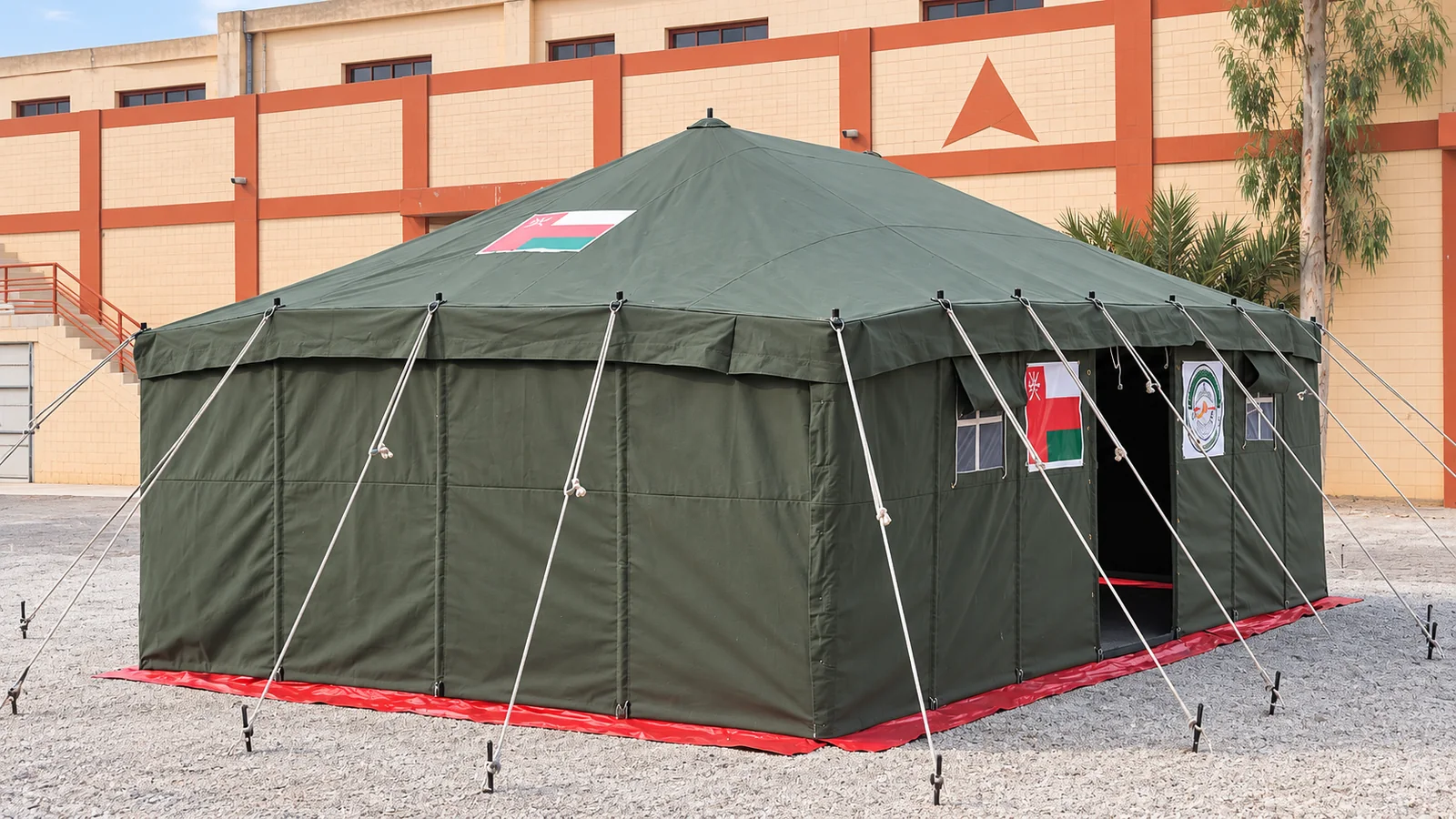
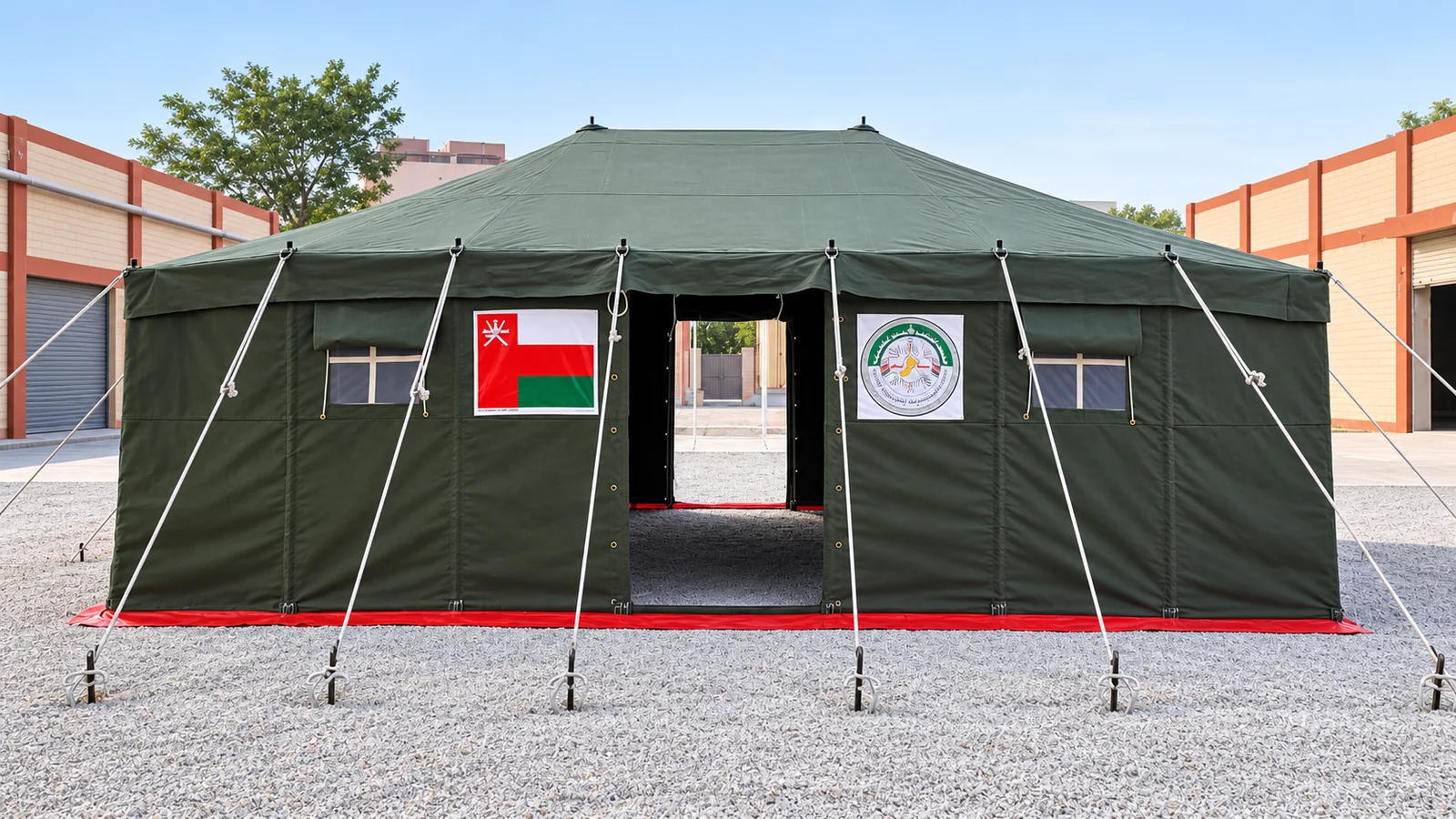
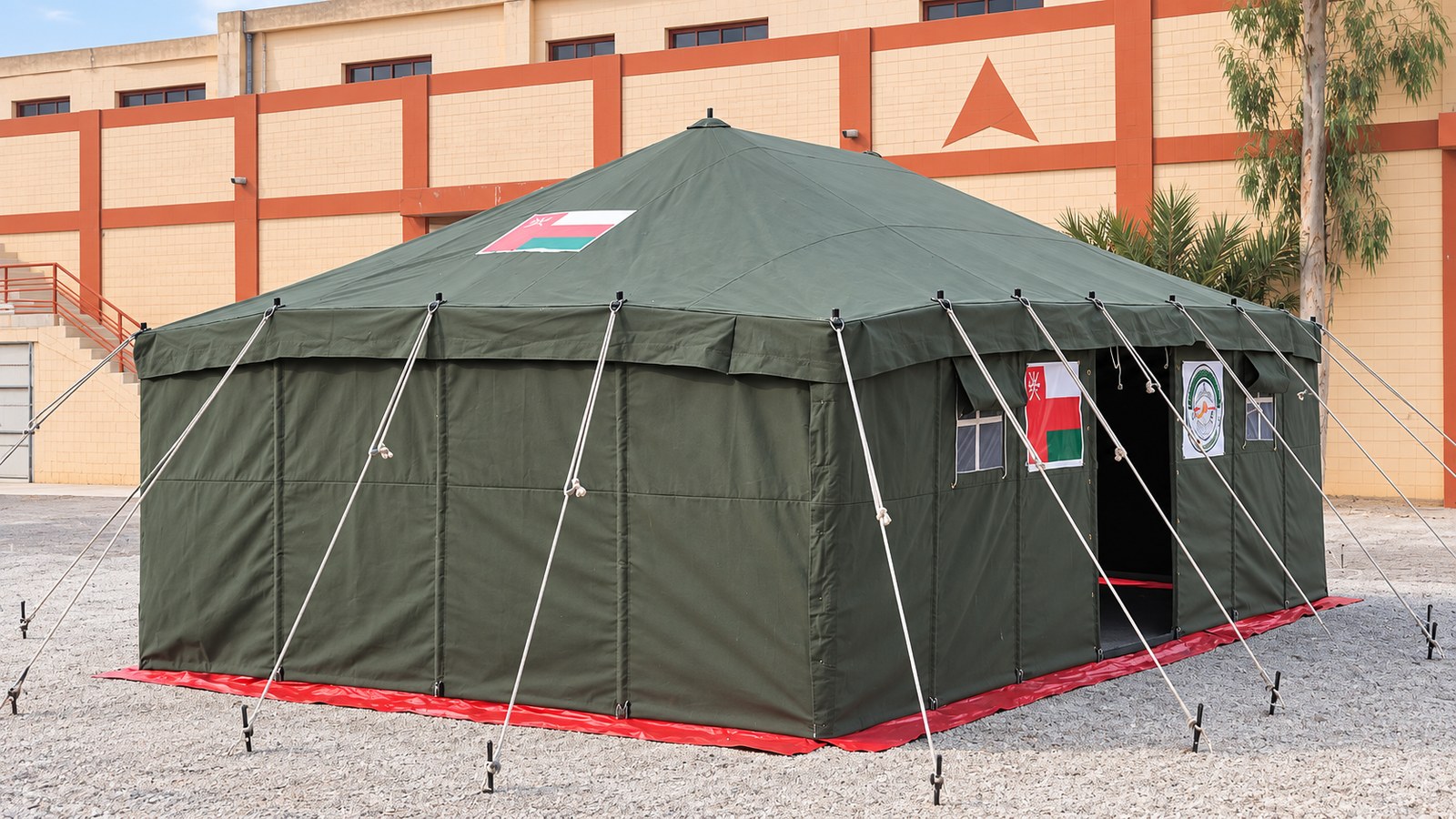
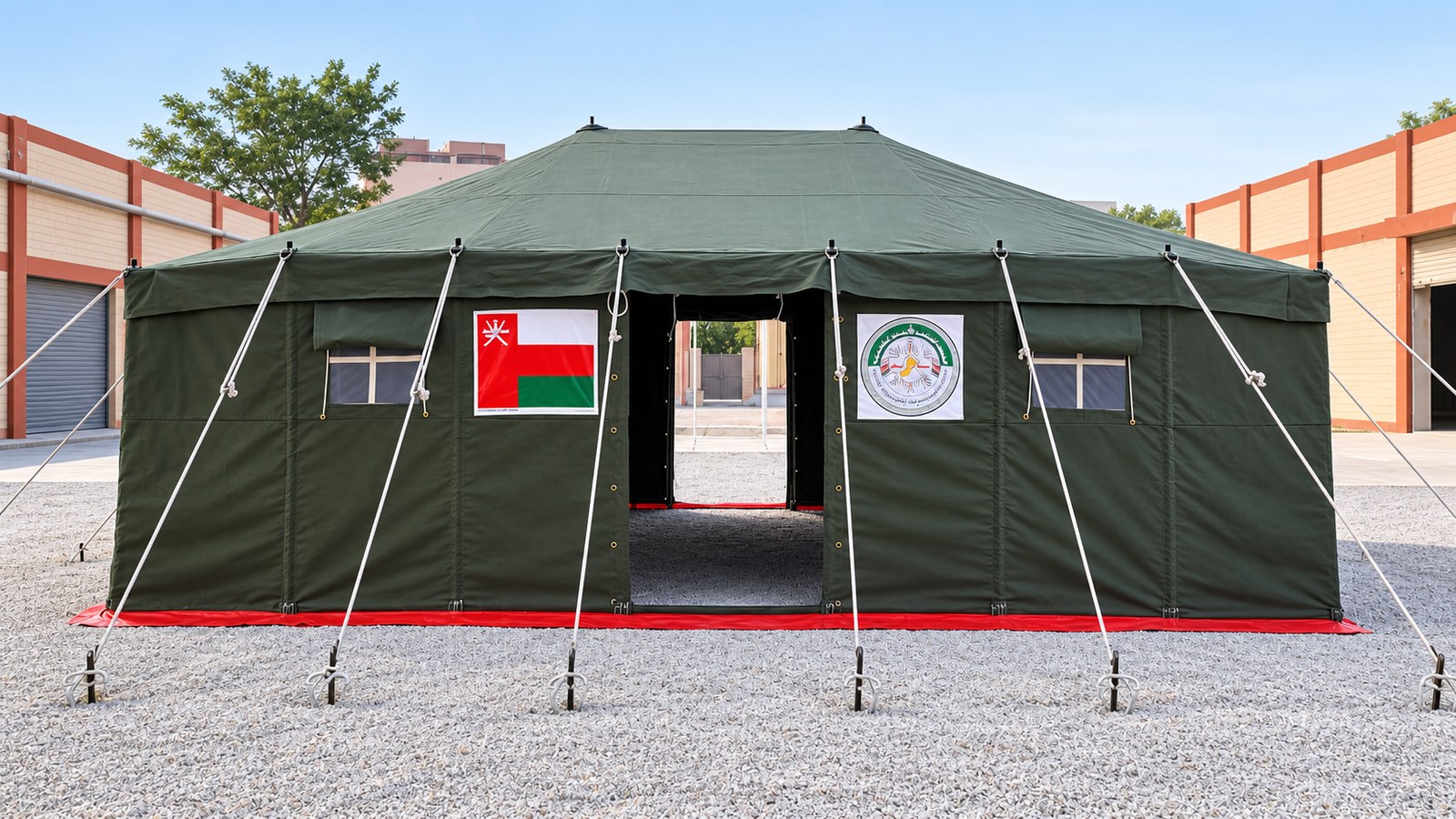
Web-refined views derived from Al Mumtaz installation photographs, showing the olive-green relief-tent roof, wall panels, framed entrance, ventilation windows, guy ropes and ground anchoring.
Attach or describe the specification, quantity, destination and delivery date. Our team will review the requirement before confirming availability and price.
Al Mumtaz Tents can quote family shelters, emergency relief tents, reception and registration tents, medical and first-aid tents, communal and dining tents, warehouse tents and other temporary camp-support structures. Final designs depend on the buyer’s technical specification, climate, quantity, packing and destination requirements.
Buyers may submit their drawings, bill of materials, test methods, lab requirements, markings and packing specification for review. A product should only be described as compliant with, approved by or supplied to a named agency after the exact design has passed that agency’s required qualification and procurement process.
Provide the tent type, dimensions or reference specification, required quantity, climate and destination, fabric and fire-performance requirements, accessories, branding, packing method, inspection requirements, delivery deadline and shipping terms.
Yes. Depending on the approved design, options can include shade flies, ventilation, insect protection and reflective layers for hot climates, or inner liners, insulation and floor-protection components for cold-weather configurations. The final solution must be matched to local hazards and buyer requirements.
Packing, component labelling, spare-parts planning, bundle dimensions, palletization and export documentation can be included in the quotation. Container loading and delivery terms are confirmed for each destination and order quantity.
No. Emergency family tents are temporary shelter solutions and are not substitutes for safe permanent housing. Camp layout, drainage, fire safety, sanitation, accessibility, protection and maintenance require coordinated planning beyond the tent itself.
No. A 680 gsm PVC insulated tunnel tent may be requested by a particular buyer, but the published UNHCR framed family-tent reference specifies different materials, including a 350 gsm polyester-cotton outer canvas. The tender’s exact specification and revision control the offer.
Humanitarian shelters are normally purchased in bulk because they are shipped, distributed and assigned to emergency operations. Al Mumtaz treats refugee-tent enquiries as sale and procurement projects rather than routine event-tent rentals, unless a buyer requests a different model.
United Nations procurement opportunities are commonly published through the United Nations Global Marketplace and individual agency supplier portals. Registration does not guarantee qualification or an award; suppliers must follow each notice, specification and submission procedure.
No affiliation or endorsement is claimed. Al Mumtaz is a UAE tent manufacturer based in Sharjah. UNHCR’s largest global stockpile is located at Dubai Humanitarian, but geographic proximity does not create agency approval, membership or a supply agreement.
A sample or prototype programme can be reviewed when the buyer provides the controlling drawings, materials, test methods, laboratory requirements and acceptance criteria. Production should not be described as qualified until the required sample and factory process have passed the applicable review.
Covered storage and logistics structures for emergency stocks and project operations.
Temporary communal dining spaces with configurable enclosure, flooring and services.
UAE project-based rental with delivery, installation and dismantling options.
Send the technical specification, quantity, destination and required delivery date for a detailed review.
